 Author:



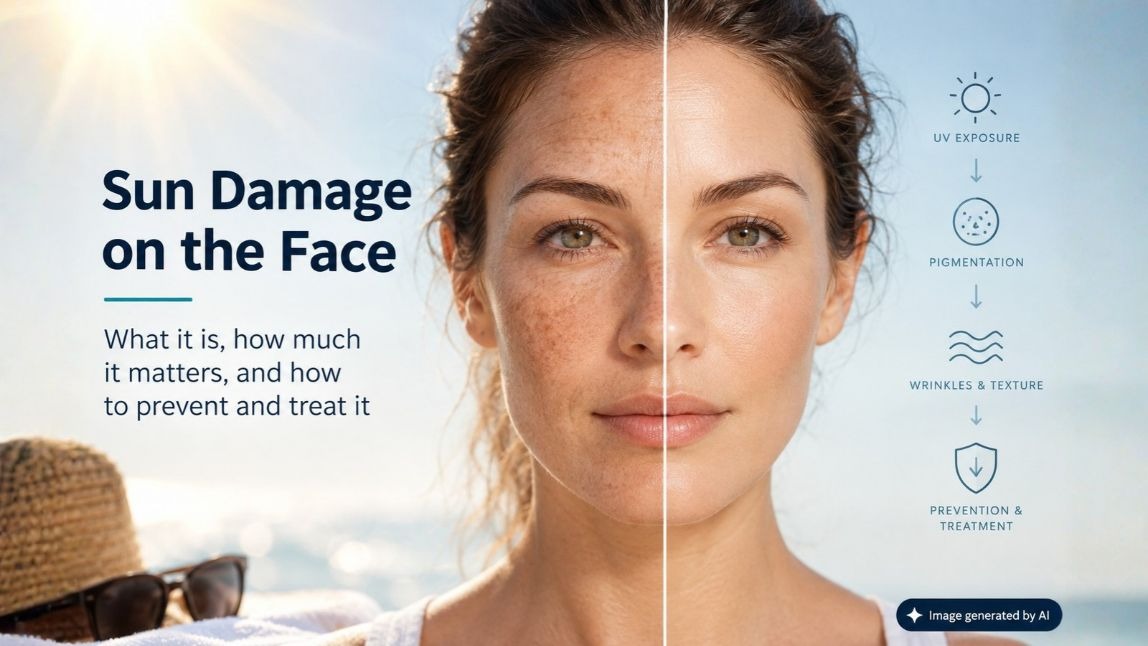
Image generated by YouCam AI
Sun damage is the rare skincare claim that is both overstated and understated at once. Overstated, because it gets blamed for every sign of facial aging including several it barely touches. Understated, because for the signs it does drive, the contribution is larger than most people believe and the evidence that prevention works is unusually good.
This guide covers what UV actually changes, which signs are sun driven and which are simply time, what can be reversed and what cannot, and how to measure it. The AI skin analysis demo scores spots, texture, wrinkles and radiance as separate values among 28 skin diagnostics across 16 skin concerns, which matters here because sun damage is not one thing and a single number cannot describe it.

What this guide covers
What Is Sun Damage on the Face?
Sun damage, or photoaging, is the accumulated structural change produced by ultraviolet exposure over years. UVB affects the surface and causes burning. UVA penetrates deeper, reaching the dermis where collagen and elastin live, and it passes through window glass, which is why the damage accumulates during ordinary days rather than only on beach holidays.
What separates it from chronological aging is that it is additive and local. It concentrates where exposure concentrates, which is why one side of the face is often visibly worse, and why the back of the hand ages faster than skin that spends its life covered.
How Much of Facial Aging Is Actually Sun?
Most of it, by one careful measurement, though the figure deserves its context.
A study of 298 women aged 30 to 78 split them into sun seeking and sun avoiding groups, had 12 trained experts score 22 clinical signs of facial aging on standardised photographic scales, and compared the two populations across four decades. The authors calculated a sun damage percentage comparing the signs affected by UV against the full set.
"UV exposure seems to be responsible for 80% of visible facial aging signs."Flament F, Bazin R, Laquieze S, Rubert V, Simonpietri E, Piot B. Effect of the sun on visible clinical signs of aging in Caucasian skin. Clinical, Cosmetic and Investigational Dermatology, 2013;6:221 to 232. doi:10.2147/CCID.S44686. The average sun damage percentage was 80.3 percent, plus or minus 4.82
Two caveats the authors themselves raise. The study was conducted in Caucasian skin, so the figures should not be transferred wholesale across skin types. And there is no genuinely unexposed control population available, since essentially everyone accumulates some lifetime exposure, which means the comparison is between more and less rather than between any and none.
The figure is also an average across signs, and the averaging hides the most useful finding in the paper, which is the next section.

Which Signs Are Sun Driven, and Which Are Not?
The same study grouped the 22 signs into four clusters and found they behaved very differently. This is the part worth knowing, because it tells you what sun protection will and will not buy you.
| Sign cluster | Relationship to sun exposure | What that means for you |
|---|---|---|
| Pigmentation | Significantly higher in the sun seeking group in every age cluster, and the cluster most strongly tied to sun status | The most specifically sun driven sign. Sun protection pays out here first and hardest |
| Wrinkles and texture | Significantly different between groups only after age 50 | Sun driven, but the gap takes decades to become visible |
| Ptosis, meaning sagging | No significant difference between sun seeking and sun avoiding groups | Chiefly time and structure rather than UV. Expect little firmness benefit |
| Vascular signs | No meaningful correlation with age or sun status, except in one age band | Redness has its own drivers. Treat it separately |
So the headline figure of around 80 percent is real but uneven. If your concern is dark spots and uneven tone, sun is almost certainly the main cause and prevention is the main lever. If your concern is a softening jawline, our guide to what actually causes jowls explains why the drivers there are structural. And if your concern is facial redness, that sits in the cluster with the weakest link to sun exposure of all.
One more detail from the same paper puts the stakes in plain terms: the authors found that a change of roughly 2 percent in their sun damage score corresponded to about three years of apparent age.
What Does Sun Damage Look Like?
| Sign | What it looks like | Where it shows first |
|---|---|---|
| Solar lentigines, sun spots | Flat brown patches with defined borders | Cheeks, temples, forehead, backs of hands |
| Uneven tone and mottling | Patchy colour without discrete spots | Across the whole face, worse on the exposed side |
| Fine lines and crepiness | Shallow lines and a crinkled surface texture | Around the eyes and upper lip |
| Coarse texture and thickening | Leathery appearance, enlarged visible pores | Nose, cheeks, forehead |
| Telangiectasia | Visible small blood vessels | Nose and cheeks |
| Loss of elasticity | Skin that recoils slowly when pinched | Cheeks and jawline, though time drives this more than UV |
| Actinic keratoses | Rough, scaly, persistent patches that may feel sharper than they look | Forehead, nose, ears, scalp. These need a clinician |
The last row is not cosmetic. Rough persistent scaly patches in chronically exposed areas should be assessed rather than treated with skincare.
A quick self check that makes the point: compare the skin on your outer forearm with the skin on your inner upper arm. Same person, same age, same genetics, very different lifetime exposure. The difference between them is a reasonable estimate of your own photoaging.

Can You Reverse Sun Damage?
Partially, and the honest answer varies sharply by sign.
| Sign | How reversible | Realistic timeline |
|---|---|---|
| Surface pigment and recent spots | Good. The most responsive sign | 3 to 6 months |
| Uneven tone | Good to moderate | 3 to 6 months |
| Fine lines | Moderate, with a retinoid | 6 to 12 months |
| Rough texture | Moderate to good | 2 to 6 months |
| Deep set spots and long standing damage | Limited topically. In clinic options do more | Months, partially |
| Visible vessels | Not with topicals. Device territory | Several sessions |
| Structural elastin damage | Largely not reversible | Manage rather than reverse |
The pattern is consistent: pigment responds, texture responds slowly, structure mostly does not. Which is also the order in which you should expect to see results, and a useful guard against abandoning a routine at week six because the deepest problem has not moved.
Does Sunscreen Actually Prevent It?
Yes, and unusually for skincare this rests on a randomised controlled trial rather than on inference.
In a randomised controlled community trial in Nambour, Australia, 903 adults under 55 were assigned to daily broad spectrum sunscreen or discretionary use over roughly four and a half years, with photoaging graded by assessors blinded to allocation. The daily sunscreen group showed no detectable increase in skin aging over the period, and aging was 24 percent lower than in the discretionary group, with a relative odds of 0.76 and a 95 percent confidence interval of 0.59 to 0.98. Beta carotene supplementation showed no overall effect. The authors noted some missing outcome data and modest power to detect moderate effects.Hughes MCB, Williams GM, Baker P, Green AC. Sunscreen and prevention of skin aging: a randomized trial. Annals of Internal Medicine, 2013;158(11):781 to 790. doi:10.7326/0003-4819-158-11-201306040-00002
Read the first result again, because it is the striking one. The daily use group did not simply age more slowly. Over four and a half years, no increase in photoaging was detectable at all. That is a stronger claim than almost anything else in skincare can support, and it comes from a design that can actually support it.
The practical specification follows from the study: broad spectrum, daily rather than on sunny days, and applied as routine rather than as an occasion. Reapplication matters on days with prolonged exposure.
What Treats Existing Sun Damage?
| Treatment | What it addresses | Timeline | Note |
|---|---|---|---|
| Daily broad spectrum SPF | Stops further accumulation | Preventive | Without it, everything below is working against a continuing cause |
| Topical retinoid | Pigment, texture, fine lines, dermal collagen | 12 weeks to 12 months | The best supported topical for photoaging overall |
| Vitamin C | Antioxidant protection and tone evenness | 8 to 12 weeks | Works best alongside sunscreen rather than instead of it |
| Niacinamide | Tone evenness, barrier support | 4 to 8 weeks | Well tolerated, easy to layer |
| Azelaic acid | Pigment and redness together | 8 to 12 weeks | Useful when both are present |
| Alpha hydroxy acids | Surface pigment and texture | 4 to 12 weeks | Increases sun sensitivity, so night use and daily SPF |
| Tyrosinase inhibitors | Targeted pigment | 8 to 16 weeks | Several require clinical supervision |
If your pigment is patchy and symmetrical rather than scattered in discrete spots, check our guide to telling melasma from other hyperpigmentation before escalating, because that pattern responds badly to aggressive treatment.
What Do In Clinic Treatments Add?
- Chemical peels for surface pigment and texture, at depths topicals do not reach.
- Intense pulsed light for discrete pigmented spots and visible vessels, usually across several sessions.
- Fractional laser resurfacing for texture and deeper pigment, with real downtime.
- Prescription topicals for actinic keratoses, which are a medical rather than cosmetic treatment.
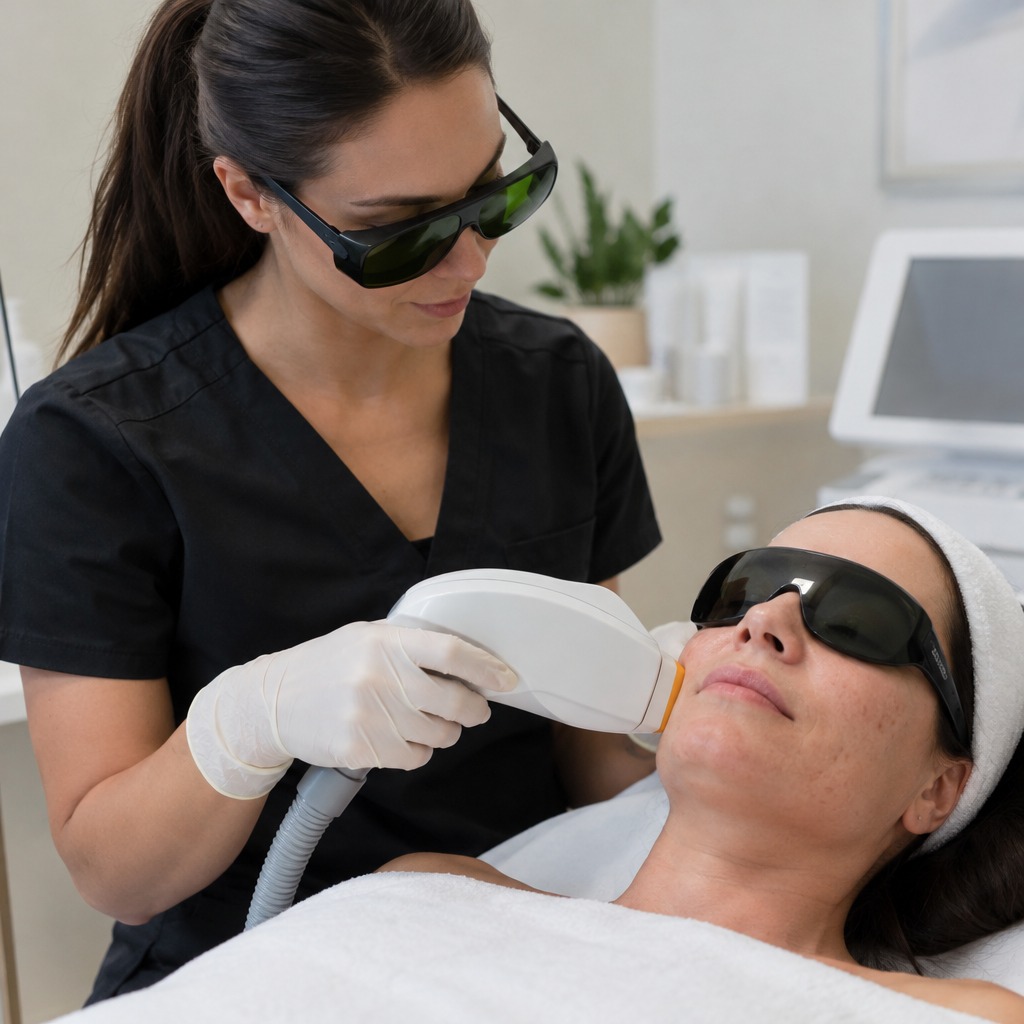
Two cautions. Device settings need to be appropriate for your skin tone, which is a question to ask directly rather than assume. And every one of these requires daily sun protection afterwards, or you are paying to remove damage you are still actively creating.
How Does a Skin Analysis API Measure Sun Damage?
By scoring the component signs rather than returning a sun damage verdict, which is the only honest approach given that the signs respond so differently.
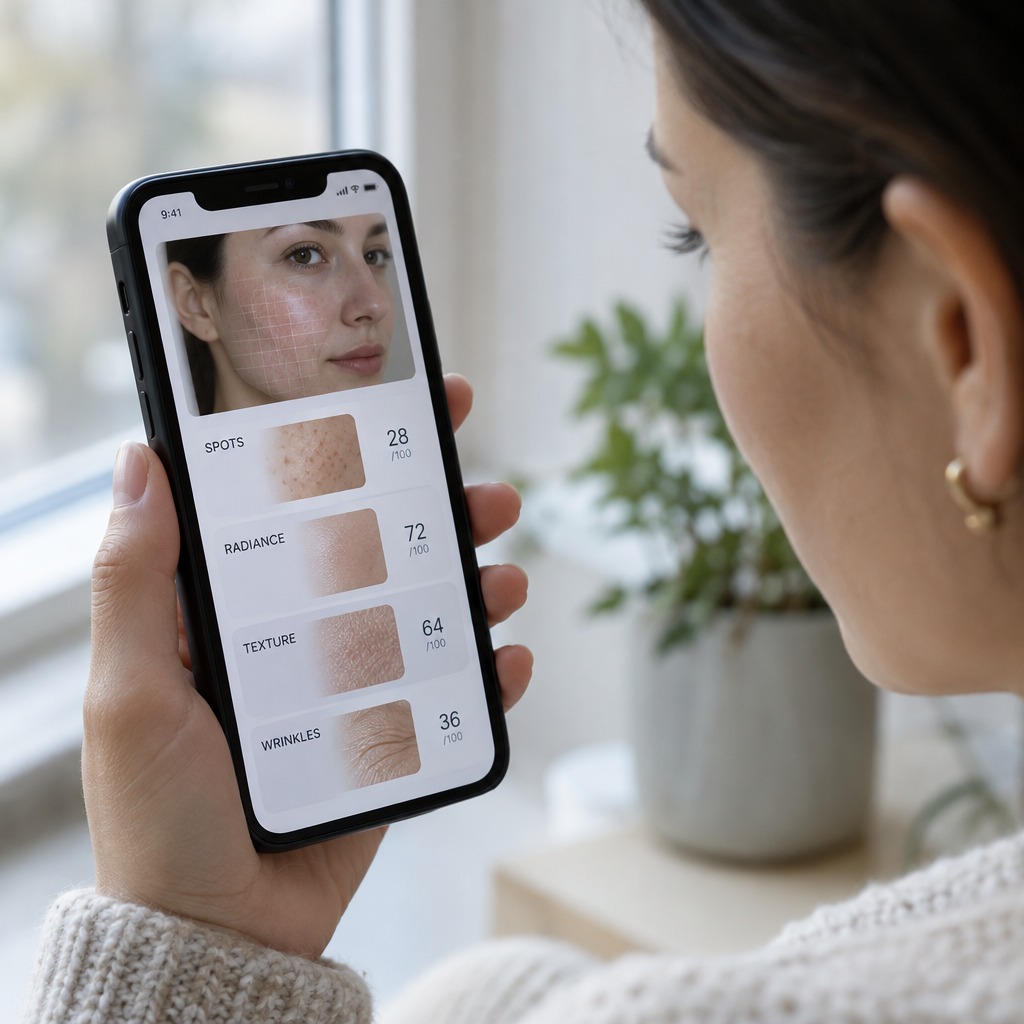
The YouCam AI Skin Analysis API returns 28 skin diagnostics across 16 skin concerns from one photograph, dermatologist verified. Four carry most of the photoaging picture.
| Scored concern | What it captures | How fast it moves |
|---|---|---|
| Spots | Discrete pigment deposits and their distribution | 3 to 6 months. The most sun specific signal |
| Radiance | Overall tone evenness and surface quality | Weeks for surface, months for pigment |
| Texture | Surface roughness and coarseness | 2 to 6 months |
| Wrinkles by region | Seven separate regions rather than one number | 6 to 12 months, and the exposed regions move first |
Reading them together is what makes this useful. High spots with normal firmness is a photoaging pattern and a tractable one. Low firmness with normal spots is chronological rather than sun driven, and sun protection will not change it much. The estimated skin age that these systems return is a composite of the same components, which is why it tends to move when pigment moves.
Skin tone representation matters for any image based pigment assessment. Research published in Science Advances, using a curated biopsy confirmed image set spanning Fitzpatrick I to VI, found that dermatology algorithms trained largely on lighter skin performed measurably worse on darker skin, and that the gap narrowed once models were tuned on more diverse data. It is a reasonable question to put to any vendor: what does your validation look like broken down by skin type.Daneshjou R, Vodrahalli K, Novoa RA, Ko J, Swetter SM, Zou J, Chiou A, et al., Disparities in dermatology AI performance on a diverse, curated clinical image set, Science Advances, 2022, doi:10.1126/sciadv.abq6147
Two limits stated plainly. These are estimates from visible signs rather than measurements of the tissue, and pigment scoring is sensitive to capture conditions, so two scans under different lighting will differ for reasons that have nothing to do with your skin. You can see the grouped output, including spots and radiance as separate readings, in the skin analysis demo.

How Do You Track Whether It Is Improving?
- Lock the lighting. Same window, same time of day, no flash. Pigment reads differently under every light source.
- Compare at three month intervals. Pigment is a slow mover and a monthly comparison mostly measures the room.
- Expect the order. Radiance and texture shift before spots do. Spots before wrinkles. Firmness probably not at all.
- Photograph both sides. Asymmetry is one of the clearest signatures of sun damage, and tracking the worse side shows change soonest.
- Use the same device. Sensor and processing differences shift fine detail and colour.
When Should You See a Dermatologist?
- Any spot that changes in size, shape, colour or border, or that looks different from your others.
- A spot that bleeds, itches persistently, crusts or does not heal.
- Rough, scaly, persistent patches in chronically exposed areas, which may be actinic keratoses.
- A new pigmented lesion appearing after about age 40.
- Any pigment that darkens despite diligent protection and consistent treatment.
- A personal or family history of skin cancer, which warrants scheduled checks rather than reactive ones.
This is worth stating directly: cosmetic skin analysis tools are not built or validated to assess moles or lesions, and a pigment score near something concerning is not an evaluation of it. Anything changing goes to a clinician.
How Should Brands Build Sun Damage Journeys?
| Signal | Route to | Why |
|---|---|---|
| High spots, younger customer | Prevention framing with daily SPF as the hero | The RCT evidence supports this claim better than any other in skincare |
| High spots, normal texture | Tone path. Vitamin C, niacinamide, SPF. State 3 to 6 months | Pigment on a hydration timeline reads as failure |
| High spots and high texture | Retinoid led routine, texture promised first | Texture is the early visible win that buys patience |
| Low firmness, normal spots | Do not frame as sun damage | The evidence says sagging is not primarily UV driven |
| Patchy symmetrical pigment | Melasma content and caution, not stronger actives | Aggressive treatment worsens this specific pattern |
| Any lesion concern reported | Professional referral, immediately and unambiguously | Outside what cosmetic scoring is built for |
Three implementation notes. Lead with sunscreen, because it is the single claim in this category that a randomised trial supports. Attach the three to six month timeline to every pigment recommendation rather than letting customers set their own expectation. And build the referral path properly, since pigment is the concern where a cosmetic tool is most likely to be looking at something medical.
You can test the per concern scoring against real images in the YouCam API Playground, or run the consumer flow in the skin analysis demo. Perfect Corp works with 800+ brand partners on experiences of this kind.
Sun Damage FAQ
How much of facial aging is caused by the sun?
One study of 298 women scoring 22 clinical signs estimated around 80 percent of visible facial aging signs are attributable to UV exposure. The contribution is uneven though: pigmentation is strongly sun driven, wrinkles and texture show a difference only after about age 50, and sagging showed no significant difference between sun seeking and sun avoiding groups.
Can sun damage be reversed?
Partially. Surface pigment and uneven tone respond well over three to six months, texture moderately, fine lines slowly with a retinoid. Structural elastin damage is largely not reversible, and visible vessels need devices rather than topicals.
Does sunscreen really prevent skin aging?
Yes. In a randomised controlled trial of 903 adults over about four and a half years, the daily sunscreen group showed no detectable increase in photoaging and 24 percent less aging than the discretionary use group. That is unusually strong evidence for a skincare claim.
How long does it take to see sun damage?
Years to decades, which is what makes it hard to act on. Pigment usually appears first, often in the thirties and forties. Texture and wrinkle differences between high and low exposure groups become statistically visible around age 50.
What does sun damage look like on the face?
Flat brown spots with defined borders, mottled uneven tone, fine lines around the eyes and upper lip, coarsened texture, visible small blood vessels, and in some cases rough scaly patches. Asymmetry between the two sides of the face is a common signature.
Is it too late to start wearing sunscreen?
No. The trial evidence measured prevention of further aging in middle aged adults, not in the young, so starting later still slows accumulation. It also stops working against the treatments you are using for existing damage.
Does sun damage cause sagging skin?
Less than most people assume. In the study comparing sun seeking and sun avoiding women, the sagging cluster showed no significant difference between the groups, while pigmentation differed in every age group. Sagging is driven more by time, bone, fat and ligament change.
Can you get sun damage through windows?
UVA passes through standard window glass, and UVA is the wavelength that reaches the dermis where collagen and elastin sit. This is why daily indoor sunscreen is advised and why drivers often show more damage on the window side.
Can a skin analysis tool detect sun damage?
It scores the components, spots, radiance, texture and wrinkles by region, among 28 diagnostics across 16 concerns, rather than returning a sun damage verdict. It is an estimate from visible signs, and it is not validated to assess moles or lesions, which require a clinician.
How often should I re-scan to track pigment?
Every three months under identical lighting. Pigment moves slowly enough that shorter intervals mostly capture variation in capture conditions rather than real change.
Protect the Signs Sun Actually Drives
Around 80 percent of visible facial aging traces back to UV, but the contribution is concentrated rather than spread evenly. Pigment is where sun dominates and where protection pays out first. Texture and wrinkles follow slowly, over decades. Sagging largely does not, whatever the marketing on a firming product implies.
What that means practically is simple. Daily broad spectrum sunscreen is the highest value habit available, and it is supported by a randomised trial showing no detectable increase in photoaging over four and a half years of daily use. Add a retinoid for what is already there, give pigment three to six months before judging it, and get anything that is changing looked at by a clinician rather than measured by an app.
Run a scan in the skin analysis demo to see spots, radiance and texture as separate baselines, test the API in the YouCam AI Playground, or contact Perfect Corp if you are building pigment scoring into a customer experience.