 Author:



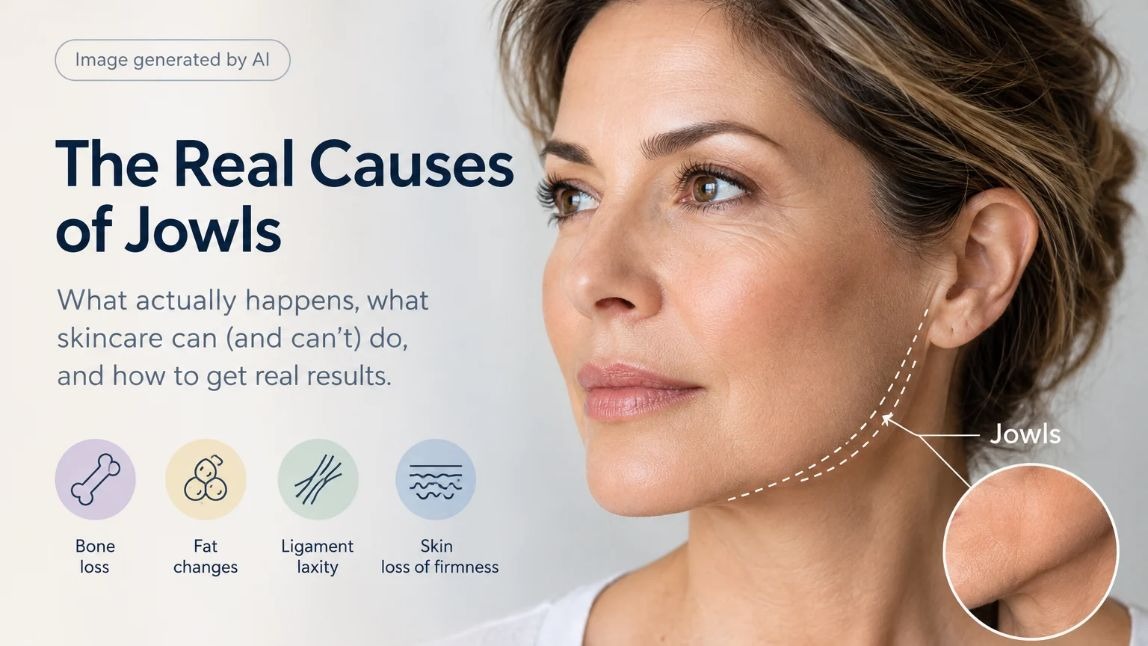
Images generated by AI
Jowls are the one aging concern where the skincare aisle is least honest, because the thing that sags is mostly not skin. The jawline softens through four separate changes happening at different depths, and only one of them is anything a cream can reach. That is not a reason to do nothing. It is a reason to know which part you are treating, so you can judge the result against what was actually possible.
This guide separates the four drivers, says what each intervention can and cannot do, and covers how to measure change rather than guess at it. The AI skin analysis demo scores firmness as its own value among 28 skin diagnostics across 16 skin concerns, which is a more reliable baseline than a photograph you took in different light six months ago.

What this guide covers
What Are Jowls?
Jowls are the soft tissue that sags below the jawline, breaking what used to be a continuous line from chin to ear into a stepped one. The visible result is a loss of definition at the lower face, often with a small hollow just in front of the jowl itself.
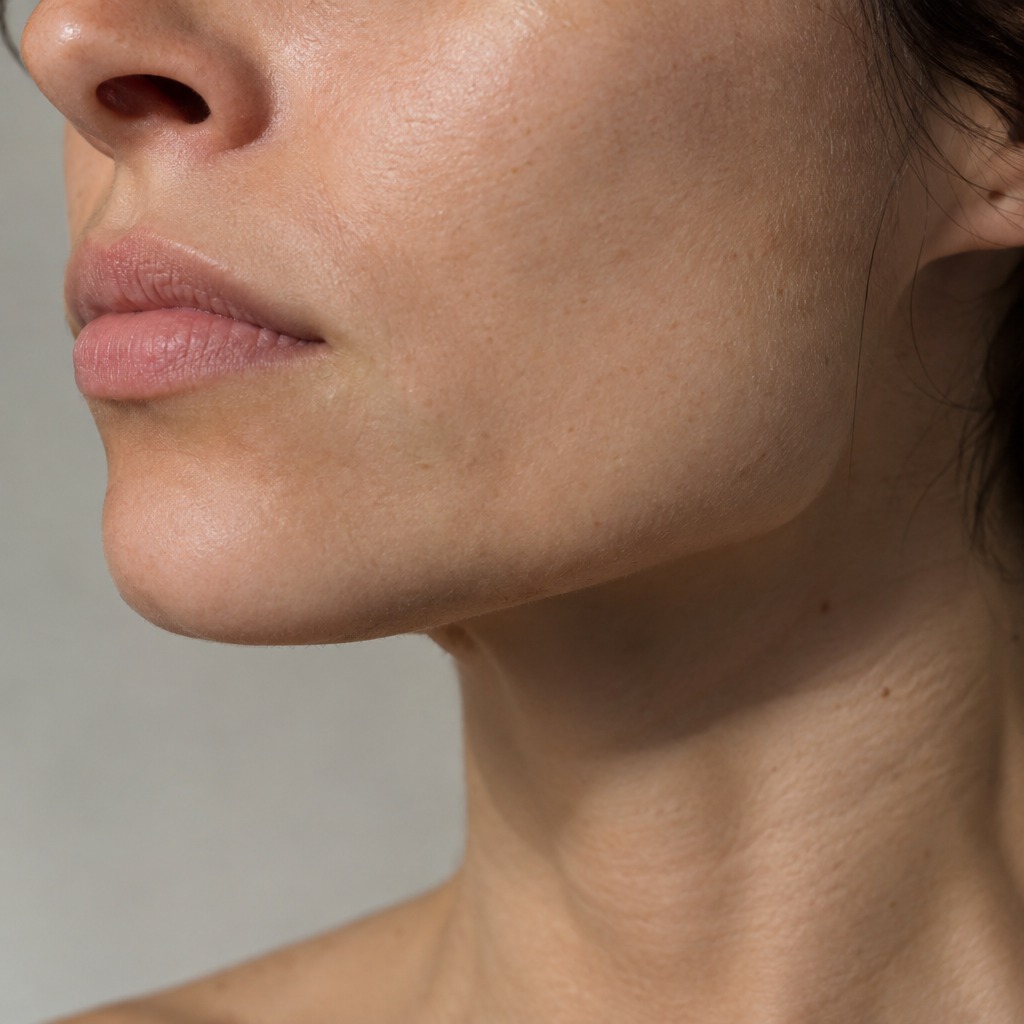
That hollow is the clue to what is going on. Jowls are not simply loose skin draped over an unchanged structure. The structure underneath changed too, and the hollow in front of the jowl sits where the bone has receded.
What Actually Causes Jowls?
Four changes, at four depths, happening simultaneously from roughly the late thirties onward.
| Driver | What changes | Can skincare reach it? |
|---|---|---|
| Bone | The jaw loses volume in specific, predictable places, including the area directly in front of where jowls form | No |
| Fat compartments | Facial fat sits in distinct pads that shrink, and the lower ones descend | No |
| Retaining ligaments | The fibrous anchors holding soft tissue to the skeleton loosen | No |
| Skin | Collagen and elastin decline, so skin has less recoil and less ability to hold what is beneath it | Yes, partially |
The skeletal part is the one most people have never heard about and the one that explains why jowls resist topical treatment.
A review in Aesthetic Plastic Surgery reports that specific areas of the facial skeleton resorb in a predictable pattern with age, and names the prejowl area of the mandible among the regions most prone to it. The authors argue that failure to address skeletal change may limit the benefit of any rejuvenation procedure, and describe skeletal correction as the new frontier in facial rejuvenation.Mendelson B, Wong CH. Changes in the Facial Skeleton With Aging: Implications and Clinical Applications in Facial Rejuvenation. Aesthetic Plastic Surgery, 2020;44(4):1151 to 1158. doi:10.1007/s00266-020-01823-x
Read that alongside the fat and ligament changes and the picture is coherent. The support underneath recedes, the padding shrinks and slides, the anchors loosen, and the skin covering all of it has less recoil than it used to. Jowls are what that combination looks like from the outside.
Is Sun Damage Responsible for Jowls?
Much less than for most other aging signs, and this is genuinely counterintuitive given how often sun protection is prescribed for sagging.
A study comparing sun seeking and sun avoiding women across four decades scored 22 clinical signs of facial aging and grouped them into four clusters: wrinkles and texture, ptosis which is the sagging cluster, pigmentation, and vascular signs. The clusters behaved very differently.
In that study, pigmentation was significantly higher in the sun seeking group in every age cluster, and wrinkles and texture differed significantly between groups after the age of 50. Ptosis, the sagging cluster, showed no significant difference between the sun seeking and sun avoiding groups at all. Ptosis correlated strongly with real age at 0.774 but only moderately with sun exposure status at 0.552.Flament F, Bazin R, Laquieze S, Rubert V, Simonpietri E, Piot B. Effect of the sun on visible clinical signs of aging in Caucasian skin. Clinical, Cosmetic and Investigational Dermatology, 2013;6:221 to 232. doi:10.2147/CCID.S44686. Based on 298 women aged 30 to 78, scored by 12 trained experts
The practical reading is not that sunscreen is pointless. It remains the most valuable habit in skincare, and it protects the collagen that makes up the one driver skincare can influence. But if you are using sun protection specifically as a jowl strategy, the evidence says sagging is chiefly a function of time and structure rather than of accumulated UV. Expect sunscreen to pay out in pigment and texture, where the same study found the effect is strongest, and treat any firmness benefit as secondary.
At What Age Do Jowls Start?
Earlier than they become visible. The underlying changes begin in the thirties and become apparent somewhere in the forties for most people, though the range is wide and largely determined by factors you do not control.
| Factor | Effect on timing | Within your control? |
|---|---|---|
| Genetics and bone structure | The largest single factor. A strong jaw and high bone density delay it considerably | No |
| Significant weight fluctuation | Repeated loss and gain stretches the skin envelope | Partly |
| Smoking | Degrades collagen and elastin directly | Yes |
| Sun exposure | Degrades dermal collagen, though it is a weaker driver here than for pigment | Yes |
| Skin thickness | Thinner skin shows underlying change sooner | No |
| Rapid weight loss in midlife | Removes fat volume faster than skin can retract | Partly |
The honest summary is that the strongest determinants of when jowls appear are the ones you were born with. What you control is the rate, not the fact.
What Can Skincare Actually Do?
It can address the skin driver, which is one of four. That is a meaningful but bounded contribution, and the bound is the part usually left out.
| Intervention | What it does | Realistic effect on jowls | Timeline |
|---|---|---|---|
| Topical retinoid | Stimulates collagen production in the dermis | The best supported topical. Improves skin quality and texture, modest effect on laxity | 12 weeks to 12 months |
| Daily broad spectrum SPF | Protects existing collagen from UV degradation | Preventive rather than corrective. Strongest for pigment and texture | Measured in years |
| Peptides | Signal collagen support | Modest, with weaker evidence than retinoids | 12 weeks and beyond |
| Vitamin C | Antioxidant support, a cofactor in collagen synthesis | Supportive, not corrective | 12 weeks |
| Rich moisturisers | Hydrates, which plumps the surface | Temporarily improves appearance. No structural effect | Immediate and temporary |
| Firming creams | Usually a combination of the above plus film formers | A short term tightening sensation. Not a lift | Hours |
The reasonable expectation from a diligent topical routine is skin that is in better condition, which makes the lower face look better, without the jawline being restored. If a product promises a lift, it is describing something that requires reaching tissue a cream does not reach.
What Does Not Work?
- Facial exercises and jaw trainers. The muscles are not the problem. Where the issue is bone resorption, fat descent and ligament laxity, building muscle underneath does not restore the contour, and some approaches may worsen volume loss.
- Face taping. Holds tissue while applied. Nothing persists after removal.
- Facial massage tools and rollers. Pleasant, temporarily reduce fluid, no effect on the drivers.
- Collagen drinks. Evidence for skin hydration and elasticity measures is mixed and modest, and there is no good evidence for reversing established jowling.
- Firming creams marketed as alternatives to a facelift. The comparison is not a comparison.
- Chewing gum for jawline definition. Builds masseter muscle, which widens rather than lifts and does not address jowling.
None of these are harmful in moderation. The issue is opportunity cost: time spent on them is time not spent on the retinoid and the sunscreen, which do have evidence behind them.
What Do In Clinic Treatments Do?
They divide neatly by which driver they target, which is the most useful way to understand the menu.
| Treatment type | Driver it targets | What to expect |
|---|---|---|
| Energy based tightening, radiofrequency and ultrasound | Skin and superficial tissue | Modest tightening over months. Best for mild laxity, not established jowls |
| Dermal filler at the prejowl and jawline | Bone volume loss and the hollow in front of the jowl | Restores contour by replacing lost volume. Temporary, repeated |
| Thread lifts | Ligament laxity and tissue position | Repositions tissue. Temporary, and results vary considerably |
| Collagen stimulating injectables | Dermal collagen | Gradual quality improvement over months |
| Surgical lift | All of them, by repositioning and removing tissue | The only intervention that reliably restores the jawline. Surgery, with everything that implies |
Note how the table maps onto the four drivers. That mapping is the single most useful thing to take into a consultation, because it turns an unfamiliar menu into a question with a structure: which driver is dominant in my face, and what addresses it.

How Does a Skin Analysis API Score Firmness?
By scoring the visible signals associated with laxity and skin quality, which is a real and bounded capability worth being precise about.
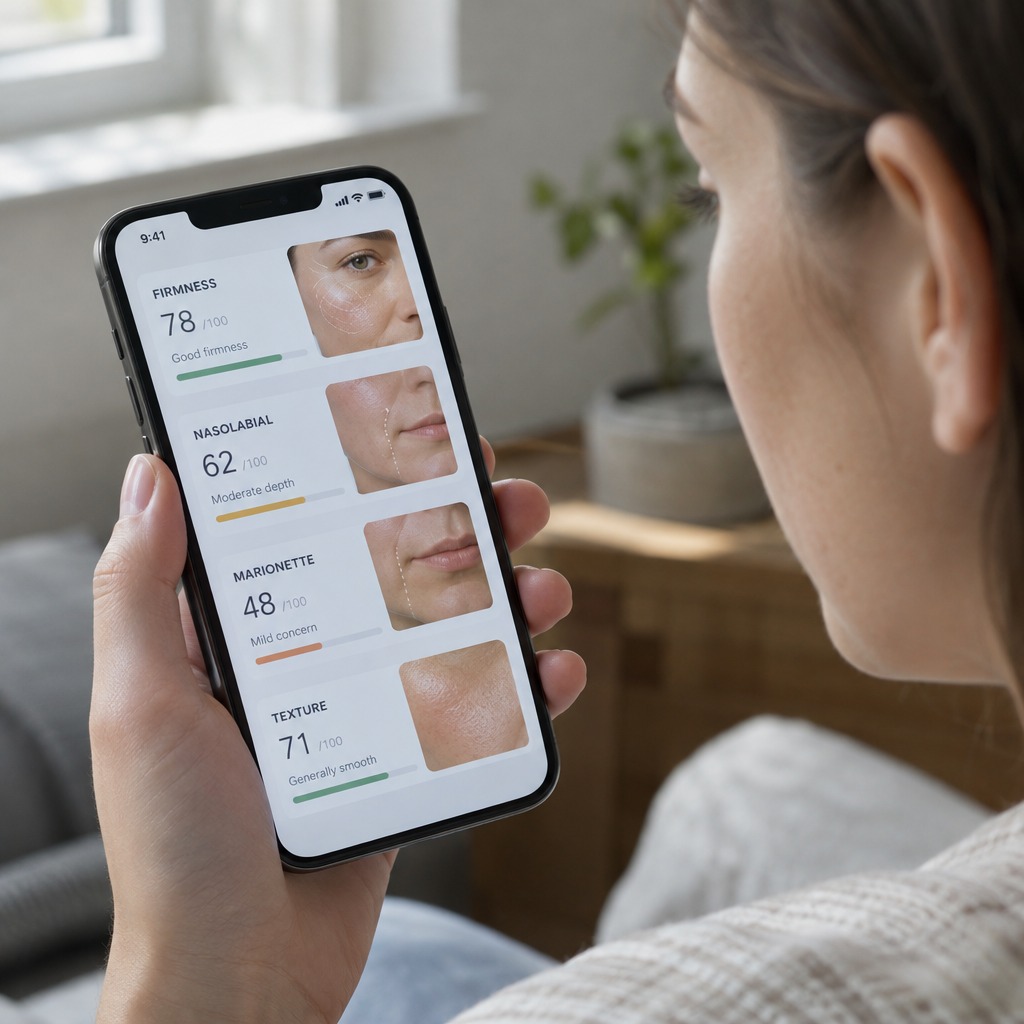
The YouCam AI Skin Analysis API returns firmness as its own value among 28 skin diagnostics across 16 skin concerns, dermatologist verified. Several related scores inform the lower face picture.
| Scored concern | What it contributes | Note |
|---|---|---|
| Firmness | The primary laxity signal | Responds slowly. Not a week to week metric |
| Nasolabial and marionette wrinkle regions | Lower face folds, scored by region rather than as one wrinkle number | These deepen as tissue descends, so they track the same process |
| Texture | Surface quality, which is what a retinoid moves first | Your earliest evidence a routine is working |
| Estimated skin age | A composite including firmness and wrinkles | Directional, not diagnostic |
Three honest limits. These are estimates from visible signs rather than measurements of the tissue, so this is not a reading of dermal collagen density. The scoring cannot distinguish skin laxity from fat descent or bone resorption, because from a photograph they produce similar appearances, which means a firmness score tells you how much the lower face has changed and not which of the four drivers did it. And firmness is a slow mover, so the useful comparison interval is months rather than weeks.
On how far image based scoring can be trusted generally, a 2025 systematic review and meta analysis in the British Journal of Dermatology covering 45 studies reported a pooled reliability coefficient of 78 percent for AI severity assessment, alongside pooled sensitivity of 80.5 percent and specificity of 96.2 percent. The authors called for more transparent data reporting and prospective studies using objective reference standards.Cai ZR, Kim J, Rezaei SJ, Chen ML, Touma F, Zhu C, Onyeka S, Fonjungo F, Omiye JA, Krakowski I, Nwandu L, Biossonnette R, Ko JM, Linos E. Assessing the performance of artificial intelligence models in evaluating inflammatory skin disease severity: a systematic review and meta-analysis. British Journal of Dermatology, 2025;193(5):847 to 855. doi:10.1093/bjd/ljaf250
Within those limits it does the thing memory cannot, which is give you a consistent number from a consistent capture. You can see firmness alongside the wrinkle regions and texture in the skin analysis demo.

How Do You Track Whether Anything Is Working?
- Fix the capture. Same light, same time of day, same distance, head level and neutral. For the lower face specifically, camera height and chin position change the apparent jawline more than any treatment will.
- Compare at three months, not three weeks. Firmness and collagen change on a long clock. A six week comparison measures noise.
- Watch texture first. It moves well before firmness, so it is your early signal that a retinoid is doing something at all.
- Take a profile and a three quarter view. Jowls are a contour change and a straight frontal photograph is the angle least able to show one.
- Judge against the realistic ceiling. Skincare addresses one of four drivers. Better skin quality with an unchanged contour is the expected good outcome, not a failure.
How Do You Prevent Jowls?
You delay rather than prevent, and the list is short because the honest list is short.
- Start a retinoid early and stay on it. The best supported topical for dermal collagen, and the earlier the better.
- Wear sunscreen daily. It protects collagen, and its strongest payoff is in pigment and texture.
- Do not smoke. It degrades collagen and elastin directly and visibly.
- Avoid repeated large weight swings. Each cycle stretches the skin envelope further than it retracts.
- Maintain muscle mass and nutrition through midlife, since facial fat loss often accompanies broader body composition change.
- Accept the genetic component. Bone structure and skin thickness set the baseline, and no routine overrides them.
How Should Brands Handle Firmness Recommendations?
Firmness is the concern where overpromising is most tempting and most costly, because customers can see for themselves whether a jawline changed.
| Signal | Route to | Why |
|---|---|---|
| Low firmness, younger customer | Prevention framing. Retinoid plus daily SPF | The highest value intervention is the earliest one |
| Low firmness, low texture | Retinoid, with texture as the promised early win | Texture moves in weeks, firmness does not. Promise the one you can keep |
| Low firmness, established lower face change | Skin quality framing, plus professional referral | Claiming a lift here is the fastest way to lose the customer |
| Low firmness with elevated redness | Barrier repair before any retinoid | Starting a retinoid on a compromised barrier fails twice |
| Firmness normal, concern reported anyway | Education, not a product | Perceived sagging is often contour and lighting rather than laxity |
Three implementation notes. Set the comparison interval at three months rather than letting customers re-scan weekly into noise. Lead with texture as the early visible win so the slow firmness work has something to stand on. And say plainly what topicals do not reach, because the customer will find out anyway, and the brand that said so first is the one still trusted afterwards.
You can test the per concern scoring against real images in the YouCam API Playground, or run the full consumer flow in the skin analysis demo. Perfect Corp works with 800+ brand partners on experiences of this kind.

Jowls FAQ
What causes jowls?
Four changes at once: bone loss in the jaw, including the area directly in front of where jowls form, shrinking and descending facial fat pads, loosening retaining ligaments, and declining collagen and elastin in the skin. Only the fourth is reachable by skincare.
Can you get rid of jowls without surgery?
You can improve the appearance. Filler restores volume where bone has receded, energy based devices tighten modestly, and thread lifts reposition tissue temporarily. Restoring the jawline reliably remains surgical. Non surgical options are real but partial.
At what age do jowls start?
The underlying changes begin in the thirties and typically become visible in the forties, with wide variation. Bone structure, skin thickness and genetics are the largest determinants of timing, more than anything in a routine.
Do face exercises get rid of jowls?
No. Muscle is not the driver, and building it does not restore a contour lost to bone resorption, fat descent and ligament laxity. Some approaches may make volume loss more apparent.
Does sun damage cause jowls?
Less than for other aging signs. In a study comparing sun seeking and sun avoiding women, the sagging cluster showed no significant difference between the two groups, while pigmentation differed significantly in every age group. Sunscreen is still worth wearing daily, chiefly for pigment and texture.
Does retinol help jowls?
It is the best supported topical, improving dermal collagen, skin quality and texture over three to twelve months. Expect better skin rather than a lifted jawline, since it addresses one of four drivers.
Can weight loss cause jowls?
Rapid or repeated weight loss in midlife can, because fat volume is removed faster than skin retracts and because facial fat loss is part of the change. Gradual loss and maintained muscle mass are gentler on the lower face.
Do firming creams work on jowls?
They improve skin condition and can create a temporary tightening sensation. They do not lift tissue, because the tissue that has moved sits deeper than a topical reaches. Judge them on skin quality rather than contour.
Can a skin analysis tool measure jowls?
It scores firmness as its own value, with nasolabial and marionette wrinkle regions and texture alongside, among 28 diagnostics across 16 concerns. It cannot distinguish skin laxity from fat descent or bone change, since those look similar in a photograph, and it moves on a timescale of months.
How long before I see a difference from a firming routine?
Texture improves in four to eight weeks and is your early signal. Firmness changes over three to twelve months and modestly. Compare photographs at three month intervals in matched conditions, and include a three quarter view, since contour does not show frontally.
Treat the Driver You Can Reach
Jowls form because bone recedes, fat shrinks and descends, ligaments loosen and skin loses recoil, in that order of difficulty for anything you can apply. A good topical routine, meaning a retinoid plus daily sunscreen started as early as you are willing, addresses the fourth driver genuinely and the other three not at all. That produces better skin on an unchanged contour, which is a real result and the one worth expecting.
If the contour itself is what bothers you, the useful question in a consultation is which driver dominates in your face, because each has a different answer. And whatever you choose, measure it properly: matched lighting, a three quarter view, and three month intervals, because this is a concern where memory flatters and photographs do not.
Run a scan in the skin analysis demo to get a firmness baseline you can repeat, test the API in the YouCam AI Playground, or contact Perfect Corp if you are building firmness scoring into a customer experience.