Author:



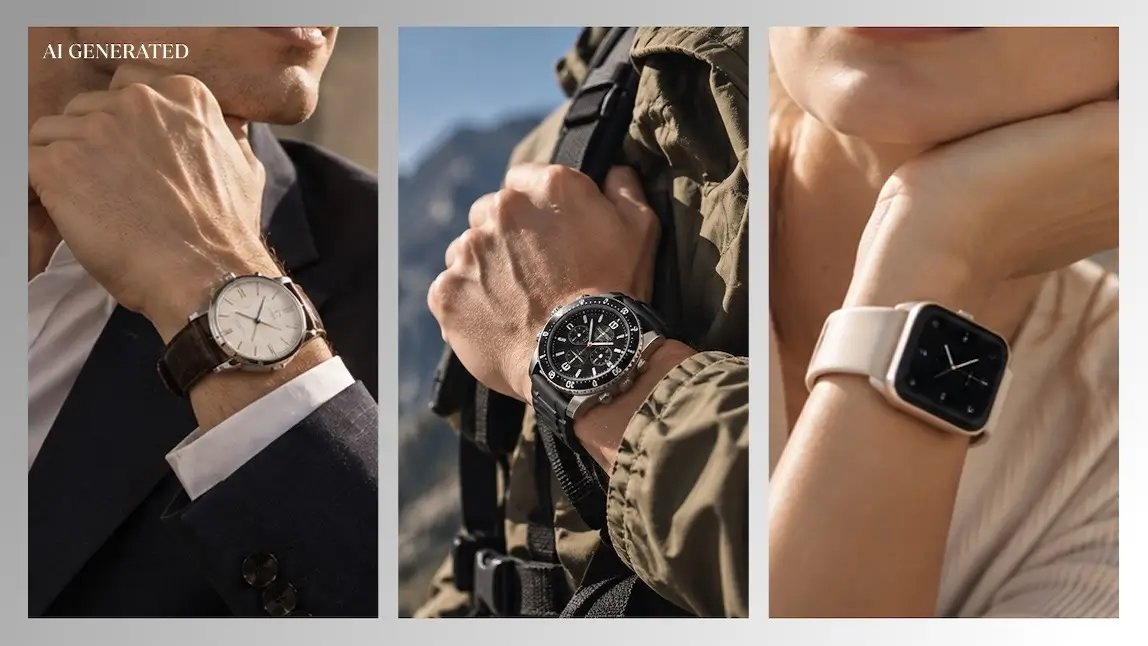
Disclaimer: Some images in this article may have been created or modified by AI
Walk into any watch store and the vocabulary starts flying: automatic, chronograph, GMT, field, diver, dress, quartz. It can feel like you need a degree just to buy something for your wrist. You do not. Most watch types fall into two simple groups: what powers the watch, and what the watch is designed to do.
This guide explains every major type of watch in plain language. You will learn the difference between movements, the 12 most common watch styles, which type suits which occasion, and how to see a watch on your own wrist before you buy. For watch retailers, we also cover how virtual try-on helps shoppers pick the right type and size online.

In this guide:
- What are the main types of watches?
- What are the types of watch movements?
- What are the 12 main watch styles?
- What is the difference between a chronograph and a chronometer?
- Which type of watch suits which occasion?
- Does watch size change by type?
- How can you see a watch on your wrist before buying?
- How do watch retailers use virtual try-on?
- FAQ
What Are the Main Types of Watches?
Watches are grouped two ways. By movement, the main types are mechanical (hand-wound), automatic, quartz, solar, and smartwatch. By style, the most common types are dress, diver, pilot, field, chronograph, GMT, racing, skeleton, digital, smartwatch, hybrid, and pocket watches. Any watch has one movement and one style, such as an automatic diver or a quartz dress watch.
What Are the Types of Watch Movements?
The movement is the engine of the watch. It decides how the watch is powered, how accurate it is, and how much care it needs.

| Movement | How it is powered | Typical accuracy | Maintenance | Best for |
|---|---|---|---|---|
| Mechanical (hand-wound) | You wind the crown every day or two | Roughly 5 to 20 seconds per day | Service every 5 to 10 years | Collectors who enjoy the ritual |
| Automatic | Winds itself as you move your wrist | Roughly 5 to 20 seconds per day | Service every 5 to 10 years; may stop if not worn | Daily wearers who want mechanical craft |
| Quartz | Battery powering a quartz crystal | About 10 to 20 seconds per month | Battery change every 2 to 5 years | Accuracy, low cost, grab-and-go |
| Solar | Light charges a rechargeable cell | Quartz level accuracy | Very low; occasional light exposure | Low maintenance, outdoor use |
| Smartwatch | Rechargeable battery and processor | Synced to your phone | Charge every 1 to several days | Fitness, notifications, payments |
A quick tip: if a watch second hand sweeps smoothly, it is usually mechanical or automatic. If it ticks once per second, it is usually quartz.
What Are the 12 Main Watch Styles?
1. Dress Watch
Thin, simple, and elegant, usually with a leather strap and a clean dial with few or no extra functions. A dress watch is designed to slip under a shirt cuff. Typical case size: 34 to 40 mm.

2. Dive Watch
Built for water, with water resistance of at least 100 meters, a rotating bezel to track dive time, screw-down crown, and highly legible luminous markers. Dive watches have become the go-to everyday sports watch.

Try a dive watch on your own wrist with AR
3. Pilot Watch
Also called an aviator watch. Large, high contrast dial, oversized crown for use with gloves, and often a triangle marker at 12 o'clock. Designed for instant readability in a cockpit.

4. Field Watch
Military roots, rugged, simple, and very legible, often on a canvas or NATO strap. A field watch is one of the most versatile and affordable styles.
5. Chronograph
A watch with a built-in stopwatch, operated by pushers on the side of the case and shown on small sub-dials. Sporty and technical looking.

Browse all Perfect Corp AR accessory try-on demos
6. GMT or Travel Watch
Shows a second time zone, usually with an extra 24-hour hand and a 24-hour bezel. Ideal for frequent travelers or anyone working across time zones.

Add AR watch try-on to your online store
7. Racing Watch
Inspired by motorsport, typically a chronograph with a tachymeter scale for calculating speed, bold colors, and a perforated rally strap.
8. Skeleton Watch
Part or all of the dial is cut away so you can see the movement working. A showpiece for mechanical watch lovers.
9. Digital Watch
Displays time as numbers on an LCD or LED screen. Practical, tough, and often packed with alarms, timers, and backlights.
10. Smartwatch
A wrist computer that pairs with your phone for notifications, fitness tracking, GPS, music, and contactless payments. The most popular watch category by volume.

See how AR watch virtual try-on works
11. Hybrid Smartwatch
Traditional analog hands with hidden smart features such as step counting and notification alerts. It looks like a classic watch but battery life lasts weeks or months.
12. Pocket Watch
Carried on a chain rather than worn on the wrist. A Full Hunter has a protective cover over the dial; a Half Hunter has a small window in the cover. Mostly worn for formal events today.
Want to see how a few of these look on your own wrist? Open the watch virtual try-on demo and switch between styles in real time.
What Is the Difference Between a Chronograph and a Chronometer?
They sound almost identical, but they describe completely different things.
| Chronograph | Chronometer | |
|---|---|---|
| What it means | A watch with a stopwatch function | A watch certified for high accuracy |
| How to spot it | Pushers on the case and sub-dials on the face | The word chronometer on the dial or papers |
| Certification | None required | Swiss watches are tested by COSC, the official Swiss chronometer testing institute |
| Can a watch be both? | Yes. A chronometer-certified chronograph has both a stopwatch and certified accuracy. | |
The extra functions a watch can have beyond telling time, like a chronograph, date, or moon phase, are called complications. The more complications, the more complex and usually expensive the movement.
Which Type of Watch Suits Which Occasion?
| Occasion | Best watch types | Strap or bracelet |
|---|---|---|
| Formal and black tie | Dress watch, pocket watch | Black or dark brown leather |
| Office | Dress watch, simple automatic, GMT | Leather or steel bracelet |
| Weekend and casual | Field, pilot, diver | NATO, canvas, or steel bracelet |
| Sports and gym | Smartwatch, digital, rubber strap diver | Rubber or silicone |
| Swimming and diving | Dive watch (100 m or more) | Rubber or steel bracelet |
| Travel | GMT, solar, smartwatch | Steel bracelet or NATO |
If you are building a small collection, a common starting trio is a dress watch, a diver, and a smartwatch or field watch.
Does Watch Size Change by Type?
Yes, and it is one of the most common reasons people return watches bought online. Dress watches tend to run small and thin, while divers, pilots, and chronographs run larger and thicker. The same 42 mm case can look perfect as a diver and oversized as a dress watch.

- Dress watches: often 34 to 40 mm, under 10 mm thick.
- Field and GMT watches: often 36 to 41 mm.
- Divers and chronographs: often 39 to 44 mm and 12 mm or thicker.
- Pilot watches: often 40 to 46 mm.
Lug-to-lug length matters as much as diameter. Our watch size guide explains how to match case size to your wrist, and the wrist size chart shows how to measure.
How Can You See a Watch on Your Wrist Before Buying?
Product photos show a watch on a model or floating on a white background. Neither tells you how a 42 mm diver will look on your 16 cm wrist. Virtual try-on does.
Build watch try-on into your app with the YouCam API
- Open a watch try-on on your phone or laptop camera and hold up your wrist.
- Switch between types. Compare a dress watch, a diver, and a smartwatch on the same wrist.
- Check proportions. The lugs should not overhang the edges of your wrist.
Perfect Corp's AR watch virtual try-on tracks your wrist in real time and renders metal, leather, and sapphire with realistic lighting, so the watch reacts to your environment as you move. A built-in wrist sizer gives true-to-scale measurements, helping you choose the right case size for your type of watch.
How Do Watch Retailers Use Virtual Try-On?
For retailers, the hardest part of selling watches online is the gap between a beautiful product photo and the shopper's own wrist. Virtual try-on closes that gap.

Talk to Perfect Corp about watch try-on for your store
- Fewer size-related returns. Shoppers see true scale on their own wrist before buying, a theme we explore in how virtual watch try-on reduces returns.
- Fast catalog setup. Perfect Corp's 2D-to-3D workflow can create a try-on from a single product image, so retailers do not need a full 3D model for every reference.
- Stacking and styling. Shoppers can pair watches with bracelets and rings to see a complete wrist look.
- Every channel. White-label support across web, iOS, and Android, with an e-commerce web module, mobile SDK, and RESTful API, plus an analytics dashboard.
Compare options in our roundup of the best virtual watch try-on solutions, test the API in the YouCam API Playground, or contact Perfect Corp for a demo.
FAQ
How many types of watches are there?
There are five main movement types (mechanical, automatic, quartz, solar, and smartwatch) and about a dozen common styles, including dress, diver, pilot, field, chronograph, GMT, racing, skeleton, digital, smartwatch, hybrid, and pocket watches.
What is the difference between automatic and mechanical watches?
Both use a mechanical movement with springs and gears. A hand-wound mechanical watch needs you to wind the crown. An automatic winds itself using a rotor that spins as you move your wrist.
Is quartz or automatic better?
Quartz is more accurate, cheaper, and needs less care. Automatic watches are valued for craftsmanship and the smooth sweep of the second hand. Neither is better overall; it depends on what you value.
What type of watch is most accurate?
Radio-controlled and smartwatches that sync to atomic time are the most accurate. Standard quartz is next, typically within seconds per month. Mechanical watches are the least accurate, usually within seconds per day.
What is a dress watch?
A thin, minimal watch, usually on a leather strap, designed to be worn with formal clothing and to slide under a shirt cuff.
What is the most versatile type of watch?
A dive watch or a simple field watch on a steel bracelet. Both work casually and in most offices, and a diver handles water too.
What does GMT mean on a watch?
GMT stands for Greenwich Mean Time. A GMT watch has an extra hand that shows a second time zone on a 24-hour scale.
Find Your Type, Then Try It On
Once you know the difference between movements and styles, choosing a watch gets much easier. Decide how you want it powered, pick the style that fits your life, and check the size on your own wrist before you buy. A two-minute try-on can save you a return and help you find the watch you will actually wear every day.