 Author:



Most advice on reducing facial redness is a list of ingredients with no ranking, no timelines and no acknowledgement that the correct first move for a large share of readers is to stop doing things rather than start. This guide ranks what works by how well it is supported, says how long each option takes, and is explicit about which parts are prescription territory.
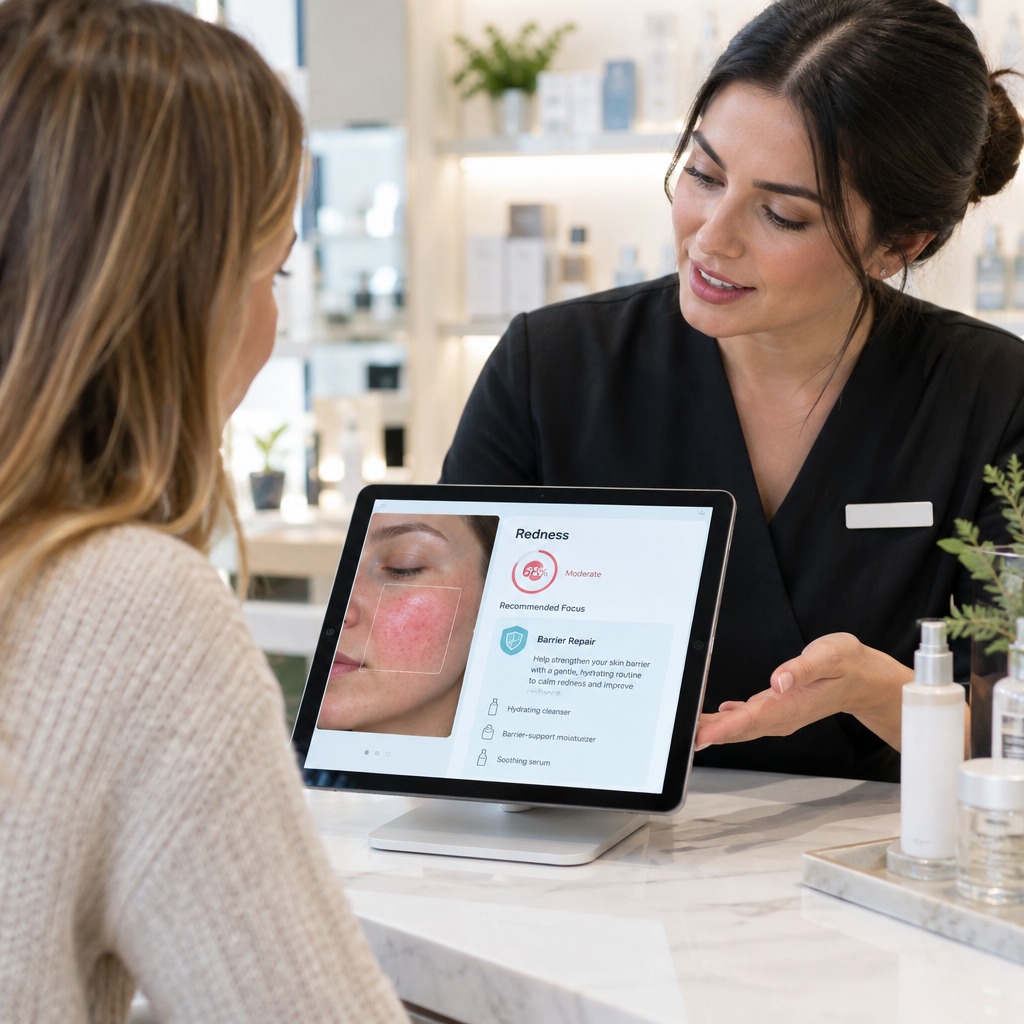
It also covers the part people skip, which is measuring whether anything changed. Redness is the fastest moving score on a skin report and the most sensitive to lighting, a combination that makes it both the easiest concern to improve and the easiest to fool yourself about. The AI skin analysis demo scores redness independently of pigment among 28 skin diagnostics across 16 skin concerns, which is a more reliable way to track it than a memory of how your face looked a fortnight ago.

What this guide covers
What Actually Reduces Facial Redness?
Ranked by how reliably each one helps, across the widest range of causes:
| Approach | How reliably it helps | Timeline |
|---|---|---|
| Remove what is irritating the skin | Very high. Fixes a large share outright | 3 days to 2 weeks |
| Daily broad spectrum sunscreen | Very high. Sun is the top reported trigger | Preventive, with benefit building over months |
| Repair the barrier | High, when stinging is present | 2 to 6 weeks |
| Identify and avoid your own triggers | High, and specific to you | Immediate once identified |
| Azelaic acid | Good, and it addresses redness and pigment together | 8 to 12 weeks |
| Niacinamide | Moderate. Supports the barrier, reduces reactivity | 4 to 8 weeks |
| Prescription topicals | High for the right presentation | Hours to weeks, depending on the drug |
| In clinic light and laser | High for visible vessels specifically | Several sessions |
| Green colour correcting makeup | Reliable, and entirely cosmetic | Instant, and it washes off |
The ordering is deliberate. The first four cost nothing, carry no risk, and between them resolve or substantially improve most facial redness. Everything below them is worth considering once those are in place, and considerably less effective before.
Why Does Subtraction Come Before Treatment?
Because for a large share of people the redness is being produced by the routine, and adding a soothing product to a routine that is causing irritation is treating a symptom while the cause continues.
In a survey of 1,066 rosacea patients, skin care products were named as a trigger by 41 percent and cosmetics by 27 percent, placing them above spicy food, humidity and indoor heating.
In the same survey, the leading reported triggers were sun exposure at 81 percent, emotional stress at 79 percent and hot weather at 75 percent, followed by wind at 57 percent, heavy exercise at 56 percent, alcohol at 52 percent and hot baths at 51 percent. The organisation notes that triggers are individual and that patients are best served by tracking their own.Rosacea Triggers Survey, National Rosacea Society, based on 1,066 patients
Two implications follow. Sun protection is not one option among many, it is the highest value single habit available. And the product shelf is a more likely culprit than most people want it to be, which is why the protocol below starts by emptying it.
What Is the Two Week Calm Down Protocol?
This is the first thing to do regardless of cause, and it is diagnostic as well as therapeutic. Whatever remains after two weeks is the real problem.
| Step | What to do | Why |
|---|---|---|
| 1. Strip the routine | Gentle cleanser, plain moisturiser, broad spectrum sunscreen. Nothing else | Removes every candidate irritant at once |
| 2. Stop all exfoliation | Acids, scrubs, cleansing brushes and cloths, retinoids | These are the most common cause of self inflicted redness |
| 3. Lower the water temperature | Lukewarm, and shorter showers | Heat both triggers flushing and strips lipids |
| 4. Change nothing else | No new soothing serum, no redness cream | A new product makes the result uninterpretable |
| 5. Keep a short log | Note heat, alcohol, stress, exercise and how your face looked | Two weeks is usually enough to surface your own triggers |
| 6. Photograph in fixed conditions | Same window, same time of day, bare skin | Memory is unreliable. A matched photo is not |
At the end of two weeks there are three possible outcomes. The redness has largely resolved, in which case the routine was the cause and you should reintroduce products one at a time, a fortnight apart. It has improved but not cleared, in which case move on to the ingredients below. Or nothing changed, which is the signal to get assessed rather than to keep experimenting.
Which Ingredients Are Worth Using?
Once the skin is calm, these are the options with the most support behind them for redness specifically.
| Ingredient | What it does | Timeline | Note |
|---|---|---|---|
| Broad spectrum SPF 30 or higher | Removes the top reported trigger | Preventive | Mineral formulas are often better tolerated on reactive skin |
| Azelaic acid | Addresses redness and pigment together | 8 to 12 weeks | Available over the counter at lower strengths and on prescription at 15 percent |
| Niacinamide | Barrier support, reduced reactivity | 4 to 8 weeks | Start low. High concentrations irritate some people |
| Ceramides and lipid replenishers | Rebuild the structure that keeps irritants out | 2 to 4 weeks | The core of barrier repair, not an optional extra |
| Glycerin and other humectants | Hydrate without irritating | Days | Dehydrated skin reads redder than it is |
| Centella asiatica and panthenol | Soothing, supportive | Weeks | Pleasant and low risk, modest effect |
| Green colour correction | Optically neutralises red | Instant | Entirely cosmetic, and an entirely legitimate choice |
What to leave out is just as important. Avoid alcohol heavy toners, fragrance, menthol, witch hazel, physical scrubs and high strength acids while redness is active. Retinoids are valuable for other concerns but should be reintroduced only once the skin is settled, and slowly.
What Prescription Options Exist?
Several, and they divide by what they actually target. This distinction matters because the drug that clears bumps does not reduce background redness, and vice versa.
| Treatment | What it targets | How it is used |
|---|---|---|
| Brimonidine 0.33 percent gel | Persistent erythema | Once daily or as needed. Peak effect lasts three to six hours |
| Oxymetazoline 1 percent cream | Persistent erythema | Once daily. Sustained effect lasts around twelve hours |
| Azelaic acid 15 percent gel or foam | Papules and pustules, mild to moderate | Twice daily |
| Ivermectin 1 percent cream | Papules and pustules, moderate to severe | Once daily |
| Metronidazole gel, cream or lotion | Papules and pustules | Once or twice daily |
| Topical minocycline 1.5 percent foam | Papules and pustules | Once daily |
| Encapsulated benzoyl peroxide 5 percent cream | Papules and pustules, mild to moderate | Once daily. Encapsulation reduces the usual irritation |
| Low dose oral doxycycline or minocycline | Papules and pustules | Once daily at sub antimicrobial doses |
The two alpha agonists in the first rows are worth understanding properly. They work by constricting blood vessels, so the effect is real but temporary and does not treat the underlying tendency. They reduce redness for a day, they do not cure it, and that is the correct way to think about them.
The American Acne and Rosacea Society's management update recommends topical alpha agonists or light and laser devices for persistent central facial erythema without papulopustular lesions, and metronidazole, azelaic acid or ivermectin with oral tetracyclines where lesions are present. It states that proper skin care, photoprotection and avoidance of patient specific triggers are suggested in all cases. Notably, no presentation in its recommendation table carries the highest evidence grade, and the authors describe the clinical management of combination therapy as more art than science.Del Rosso JQ, Tanghetti E, Webster G, Stein Gold L, Thiboutot D, Gallo RL. Update on the Management of Rosacea from the American Acne and Rosacea Society. Journal of Clinical and Aesthetic Dermatology, 2020;13(6 Suppl):S17 to S24. PMCID: PMC7710291
That last point is worth sitting with. Even the specialist guidance rests on moderate quality evidence and acknowledges considerable judgement, which is a reasonable argument for starting with the free, low risk measures and escalating deliberately rather than chasing the strongest available option first.
What Do In Clinic Treatments Do?
They address the thing topicals cannot, which is visible blood vessels that have become permanent.
- Intense pulsed light and vascular lasers target the vessels themselves and are the standard approach for telangiectasia and for background erythema that has not responded to topicals. Typically several sessions.
- Expect maintenance rather than a cure. Treated vessels resolve, but the underlying tendency remains, so new ones can appear over years.
- Settings matter by skin tone. Device based treatment of redness requires appropriate parameters for deeper skin, which is a question to ask directly before booking.
- Calm the skin first. Treating over an irritated barrier produces a worse result and a harder recovery.
The specialist guidance above lists devices as a first line option for persistent erythema without lesions, which is a reasonable signal that this is not a last resort so much as a different tool for a different sign.

What Makes Facial Redness Worse?
| Factor | Why it worsens redness | What to do |
|---|---|---|
| Sun exposure | The single most reported trigger, and cumulative | Daily SPF, reapplied, every month of the year |
| Over exfoliation | Damages the barrier, which produces redness directly | Stop entirely while redness is active |
| Hot water and saunas | Dilates vessels and strips lipids at once | Lukewarm water, shorter showers |
| Alcohol | Vasodilation, reported by over half of patients | Track which drinks affect you rather than eliminating all |
| Harsh or foaming cleansers | Lipid loss, leading to a weaker barrier | One gentle cleanse daily |
| Fragrance, menthol, alcohol in products | Direct irritation on reactive skin | Read the label, not the marketing |
| Cold wind | Barrier disruption plus vascular response | Barrier cream before exposure, not after |
| Stress | Second most reported trigger | Harder to action, but worth taking seriously |
How Long Does Each Approach Take?
| What you are doing | First visible change | Full effect |
|---|---|---|
| Removing an irritating product | 3 to 7 days | 2 weeks |
| Barrier repair | 1 to 2 weeks | 4 to 6 weeks |
| Avoiding an identified trigger | Immediate | Ongoing |
| Niacinamide | 4 weeks | 8 weeks |
| Azelaic acid | 4 to 8 weeks | 12 weeks |
| Topical alpha agonist | Within hours | Temporary by design, lasting hours per application |
| Oral tetracycline at low dose | 4 to 8 weeks | 12 weeks |
| Light or laser for vessels | After the first session | Several sessions, then maintenance |
| Post inflammatory erythema fading | 4 to 8 weeks | 3 to 6 months |
The spread explains most of the frustration with this concern. One row works in hours and several take three months, and people routinely judge a twelve week treatment at week four and conclude it failed.
How Do You Know If It Is Working?
Not by looking in the mirror, which is the least reliable instrument available for a concern that changes within the hour.
- Fix your conditions. Same window, same time of day, bare skin, no flash, same distance. Redness is the most lighting sensitive thing on your face.
- Wait at least an hour after anything that warms you. Exercise, a hot shower, a hot drink and alcohol all show, and all of them resolve.
- Compare at two week intervals, not daily. Day to day variation in redness is large enough to swamp real change.
- Look for the trend across three points, not the difference between two. Two readings are a coin flip. Three in a direction is a signal.
- Score it rather than judging it. A number from a consistent system is a better record than an impression, particularly when you are trying to decide whether to stay the course on a twelve week treatment.
That last point is where a scan earns its place. Running the skin analysis demo under matched conditions at the start, at two weeks and at six weeks gives you a redness value alongside moisture and texture, which also tells you whether the barrier repair is landing. Because redness is the fastest moving of those scores, it is usually the first evidence you get that a change is working at all.
On the broader question of whether software can grade skin reliably, a 2025 systematic review and meta analysis in the British Journal of Dermatology covering 45 studies reported a pooled reliability coefficient of 78 percent for image based AI severity assessment, with pooled sensitivity of 80.5 percent and specificity of 96.2 percent. The authors called for more transparent data reporting and prospective studies, and noted that 35 of the 45 studies did not report skin tone at all.Cai ZR, Kim J, Rezaei SJ, Chen ML, Touma F, Zhu C, Onyeka S, Fonjungo F, Omiye JA, Krakowski I, Nwandu L, Biossonnette R, Ko JM, Linos E. Assessing the performance of artificial intelligence models in evaluating inflammatory skin disease severity: a systematic review and meta-analysis. British Journal of Dermatology, 2025;193(5):847 to 855. doi:10.1093/bjd/ljaf250
Two honest caveats. The score is an estimate from visible signs rather than a measurement of the tissue, and if your capture conditions drift, the number drifts with them. Lock the conditions or do not bother comparing.
What Should You Do If Nothing Helps?
- Get assessed, because persistent redness that resists gentle care is usually a condition rather than a habit, and several of the effective treatments are prescription only.
- Check whether you are actually treating redness. If the area does not blanch under pressure it is pigment, and a different approach applies, which our guide to red versus brown blotchiness covers.
- Review the possibility that your calm down period was not clean. Reintroducing one product at week one makes the whole fortnight uninterpretable.
- Consider whether a medication you take could be contributing, which is a conversation with the prescriber rather than a reason to stop anything.
- Ask specifically about devices if you can see individual vessels, since no topical removes those.
- Seek care promptly for redness with pain, swelling, warmth, eye involvement or symptoms elsewhere in the body.
Persistent facial redness is common enough to be worth taking seriously rather than tolerating. A meta analysis pooling 32 studies across more than 26 million individuals estimated rosacea prevalence in the general population at 5.46 percent, concentrated between the ages of 45 and 60, and found that prevalence estimates depended on the diagnostic method used.Gether L, Overgaard LK, Egeberg A, Thyssen JP. Incidence and prevalence of rosacea: a systematic review and meta-analysis. British Journal of Dermatology, 2018;179(2):282 to 289. doi:10.1111/bjd.16481
How Should Brands Build Redness Recommendations?
Redness is a high intent moment and a high risk one, because the obvious commercial move is usually the wrong clinical one.
| Signal | Route to | Why |
|---|---|---|
| High redness, low moisture | Barrier repair and a stripped routine | Selling actives here loses the customer and worsens the skin |
| High redness, normal moisture | Trigger education plus soothing actives | The information is worth more than the product |
| High redness, high acne | Sequence barrier first, acne second | Aggressive acne treatment on inflamed skin backfires |
| Normal redness, high spots | Pigment path, not redness | The customer's complaint will say uneven tone for both |
| Persistent across several scans | Professional referral | The cheapest credibility a brand can buy |
Three implementation notes. Return redness as its own score rather than blending it into a general evenness number, because the vascular and pigment paths diverge completely. Attach a timeline to every recommendation, since a twelve week ingredient judged on a two week expectation reads as failure. And enforce capture conditions on the re-scan, because redness is the score most likely to move for reasons that have nothing to do with the customer's skin.
You can test the per concern output against real images in the YouCam API Playground, or run the full consumer flow in the skin analysis demo. Perfect Corp works with 800+ brand partners on experiences of this kind.

How to Reduce Facial Redness FAQ
How do I get rid of redness on my face fast?
For same day reduction, a cool compress, avoiding heat and triggers, and green colour correcting makeup are what genuinely work. Prescription topical alpha agonists reduce visible redness within hours but wear off after three to twelve hours depending on the drug. Nothing resolves the underlying cause quickly.
What is the fastest way to calm red irritated skin?
Stop everything except a gentle cleanser, a plain moisturiser and sunscreen, and lower your water temperature. Irritation from products usually improves within three to seven days of removing the cause, which is faster than any product you could add.
What ingredients reduce facial redness?
Azelaic acid and niacinamide have the most support for redness specifically, alongside ceramides for barrier repair and humectants for hydration. Daily broad spectrum sunscreen outperforms all of them, because sun exposure is the most frequently reported trigger.
Should I use retinol if my face is red?
Not while it is actively red or stinging. Retinoids are valuable for other concerns but will worsen a compromised barrier. Reintroduce only once the skin has been settled for a week or more, at a low frequency, and build up slowly.
Does niacinamide help with redness?
It supports the barrier and reduces reactivity, which helps redness driven by irritation and barrier damage, typically over four to eight weeks. Start at a lower concentration, since high strength formulas irritate some people and make the problem worse.
Can sunscreen reduce facial redness?
Yes, and it is the single highest value habit for this concern. Sun exposure was the most commonly reported trigger in a survey of over a thousand patients, at 81 percent. Mineral formulas are often better tolerated on reactive skin.
How long does it take to reduce facial redness?
Removing an irritant shows in three to seven days. Barrier repair takes two to six weeks. Azelaic acid and oral treatments take eight to twelve weeks. Prescription alpha agonists work within hours but are temporary by design.
Is there a cure for facial redness?
Redness caused by irritation or a damaged barrier resolves once the cause is removed. Chronic conditions such as rosacea are managed rather than cured, though management can be very effective. Visible individual vessels require in clinic treatment rather than skincare.
Why does my face get red after washing it?
Usually water temperature, cleanser strength, or friction from a cloth or brush. Hot water both dilates vessels and strips lipids. Switch to lukewarm water, a gentle non foaming cleanser once a day, and pat dry rather than rubbing.
How can I track whether my redness is improving?
Photograph or scan under fixed conditions, same light, same time of day, bare skin, and compare at two week intervals rather than daily. Redness varies enough hour to hour that only a matched comparison across three or more points tells you anything.
Take Things Away First
The most effective treatment for facial redness, for more people than any ingredient on this page, is two weeks of doing less. Strip the routine, stop exfoliating, lower the water temperature, wear sunscreen every day, and change nothing else. That alone resolves a large share of cases and gives everyone else a clean baseline from which the real cause becomes visible.
After that, escalate deliberately rather than aggressively. Azelaic acid and niacinamide over two to three months, prescription options if the presentation calls for them, devices if you can see individual vessels. And measure it properly, because redness moves fast enough to reward patience and varies enough hour to hour to punish guessing.
If you want to see where you are starting from, run a scan in the skin analysis demo and note the conditions so you can repeat them. Our companion guide covers how to work out which kind of red face you have, which is worth reading first if you are not sure.